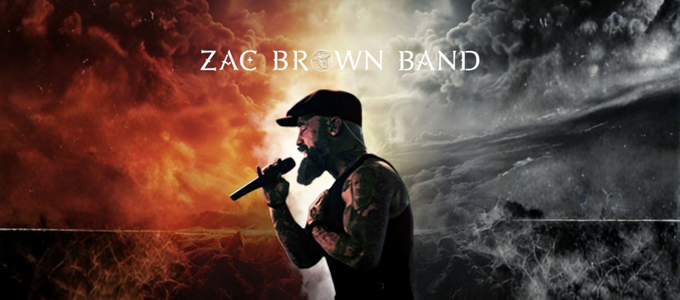
At Hard Rock Live in Hollywood, the Love & Fear Tour made a compelling case for something technology still can’t manufacture: the chemistry, versatility and unmistakable humanity of extraordinary musicians making music together.
There is something almost defiant about watching Zac Brown Band perform in 2026.
We are living through an era obsessed with removing friction from creativity. Artificial intelligence can generate a song in seconds. Software can correct a singer’s pitch, quantize a drummer’s timing and transform an imperfect performance into something technically pristine. Increasingly, the question surrounding music—and nearly every other creative field—is how much of what humans do can eventually be replicated by machines.
Then ten extraordinarily talented musicians walk onto a stage, and for a few hours the question suddenly seems beside the point.
Zac Brown Band brought its Love & Fear Tour to Hard Rock Live at Seminole Hard Rock Hotel & Casino Hollywood on Saturday night, September 19, for a sprawling, genre-defying performance that was less a traditional country concert than a masterclass in musicianship.
But what happened onstage made a simpler argument.
Talent still matters.
A Band in the Truest Sense of the Word
It would be easy to call Zac Brown one of the night’s most versatile performers.
He moved among guitar, piano and percussion throughout the show, shifting naturally between intimate acoustic moments and the full force of one of contemporary music’s most accomplished touring bands.
But focusing exclusively on Brown would miss what makes this incarnation of Zac Brown Band remarkable.
The surprise isn’t that the band contains exceptional instrumentalists. It’s discovering how inadequately the word instrumentalist describes many of them.
Throughout the evening—and particularly during an extraordinary encore—the musicians repeatedly stepped outside the roles audiences ordinarily associate with them. Players became lead singers. Multi-instrumentalists moved between instruments and genres. The spotlight traveled around the stage rather than remaining permanently fixed at its center.
That versatility isn’t accidental.
ZBB multi-instrumentalist Clay Cook has described the members as coming from wildly different musical influences and the band’s covers as an expression of that collective identity. Guitarist and keyboardist Coy Bowles has offered an even simpler explanation for the band’s seemingly bottomless repertoire: covers have been part of Zac Brown Band’s history from the beginning, born from playing bars for hours at a time and learning how to entertain people who didn’t yet know their original music.
Decades later, that apprenticeship still shows.
From Dolly and Buffett to Bad Bunny
To an outsider, the night’s musical range may have seemed comically broad. To fans, it was a tribute to the evolution of the truly unique sound the band now embodies—a sound that has long moved comfortably beyond country, absorbing rock, soul, Southern influences and reggae.
ZBB staples including “Toes,” “Keep Me in Mind,” “No Hurry,” “Knee Deep,” “Colder Weather” and “Chicken Fried” shared a show with tributes and covers that wandered unapologetically through generations and genres. Even before the encore, “Boat” flowed into Bob Marley’s “One Love,” a transition that felt less like a detour than a reminder of how naturally reggae has become part of the band’s musical vocabulary.
There were poignant acknowledgments of two enormous losses in music: Jimmy Buffett and Dolly Parton.
Parton’s presence was particularly fresh. She died August 25, less than a month before Saturday’s show. ZBB has been performing “Butterfly,” Brown and Parton’s collaboration from Love & Fear, as a tribute.
At Hard Rock Live, prerecorded vocals allowed voices no longer physically present to mingle with a live performance unfolding in real time.
It was technology doing something worthwhile in music—not replacing the human being, but helping preserve the connection to one.
Then came the encore.
And the entire premise of the show seemed to reveal itself.
Rather than returning for a predictable procession of additional hits, the band essentially handed the stage around. One member after another stepped forward to lead a song, creating a musical sprint through the influences that helped make Zac Brown Band what it is.
The Eagles’ “Heartache Tonight.” Marvin Gaye’s “Let’s Get It On.” Beck’s “Loser.” The Box Tops’ “The Letter.” Bad Bunny’s “Tití Me Preguntó.” Sia’s “Chandelier.” John Mellencamp’s “Pink Houses.” The Outfield’s “Your Love.” Don McLean’s “American Pie.” And finally, Lynyrd Skynyrd’s “Free Bird.”
It shouldn’t have worked nearly as well as it did.
It did.
Then Daniel de los Reyes Stole the Show
Among a band overflowing with talent, percussionist Daniel de los Reyes managed one of the night’s most exhilarating surprises.
Stepping out from behind the percussion setup, de los Reyes took over the stage for Bad Bunny’s “Tití Me Preguntó.”
The crowd roared.
For an artist known primarily to many casual fans as the percussionist standing amid ZBB’s formidable rhythmic machinery, the performance was a reminder of exactly what this encore was designed to reveal: these aren’t musicians capable of doing one thing exceptionally well.
They’re musicians. Full stop.
The song also represented something larger about the evening. Country shared a stage with Latin music. Southern rock sat comfortably beside soul. Sia could follow Bad Bunny; Don McLean could lead into Lynyrd Skynyrd.
Nobody seemed particularly concerned with which box any of it belonged in.
For a tour built around Love & Fear, there was something fitting about that.
For a few hours, thousands of people with different backgrounds, ages and musical tastes simply experienced it together.
The Part AI Can’t Reproduce
Perhaps artificial intelligence eventually becomes capable of producing music indistinguishable from something humans created.
Maybe, in some contexts, it already can.
But standing inside Hard Rock Live Saturday night suggested that sonic output isn’t actually the most interesting thing about live music.
Technology can reproduce sound. It can correct pitch. It can generate instrumentation. It can identify patterns across millions of songs and construct something statistically likely to please us.
What it cannot reproduce is the history that arrives onstage with ten human beings.
The years spent playing nearly empty bars. The influences accumulated independently over lifetimes. The musician watching another musician and responding in real time. The risk that someone might miss a note. The decision to hand a percussionist the microphone for a Bad Bunny song in the middle of a country concert—and the spontaneous roar of several thousand people when he absolutely owns it.
Perhaps our obsession with asking whether AI can recreate human creativity is leading us toward the wrong question.
Maybe the better question is:
Why are we so determined to replace something humans already do beautifully?
And then John Driskell Hopkins walked into the spotlight.
What Technology Should Be Trying to Change
John Driskell Hopkins—Hop to seemingly everyone who knows him—is a founding member of Zac Brown Band, a vocalist and multi-instrumentalist.
He also has ALS.
Hopkins was diagnosed in December 2021 after noticing changes that began subtly: stiffness in his hands and legs, difficulty playing guitar at his previous speed, changes in his movement onstage and, at times, his speech.
Nearly five years later, he is still here.
Still touring. Still singing. Still making music.
And when his turn came during Saturday night’s encore, Hopkins stepped forward to close the musical journey with “Free Bird.”
Suddenly, an evening that had demonstrated everything human musicians can do became a reminder of how fragile the human machinery responsible for doing it actually is.
ALS is a progressive neurodegenerative disease. Hopkins and his wife, Jennifer, responded to his diagnosis by founding Hop On A Cure, an organization dedicated to accelerating ALS research and finding a cure.
And here is where the story of technology and humanity takes an unexpected turn.
Hop On A Cure says it has awarded more than $5 million in research grants, supporting work that includes gene therapy, biomarker identification, advanced disease modeling—and artificial-intelligence-driven drug discovery.
There it is.
Perhaps that is where the extraordinary computational power we’re building becomes most exciting.
Not because machines might someday make a convincing Zac Brown Band song.
Because they might someday help John Driskell Hopkins—and the thousands of people living with ALS alongside him—have more tomorrows.
Saturday night ended with a man approaching five years since an ALS diagnosis standing onstage with the band he helped build, singing one of rock music’s great declarations of freedom.
There are moments a review doesn’t need to improve upon.
This was one of them.
Maybe the future of technology isn’t about teaching machines to do the things human beings already do beautifully.
Maybe it’s about giving human beings more time to keep doing them.
Support Hop On A Cure
John Driskell Hopkins and his wife, Jennifer, founded Hop On A Cure to support research aimed at preventing, reversing and curing ALS. To learn more about Hop’s work, support ALS research or contribute to the organization’s mission, visit HopOnACure.org.