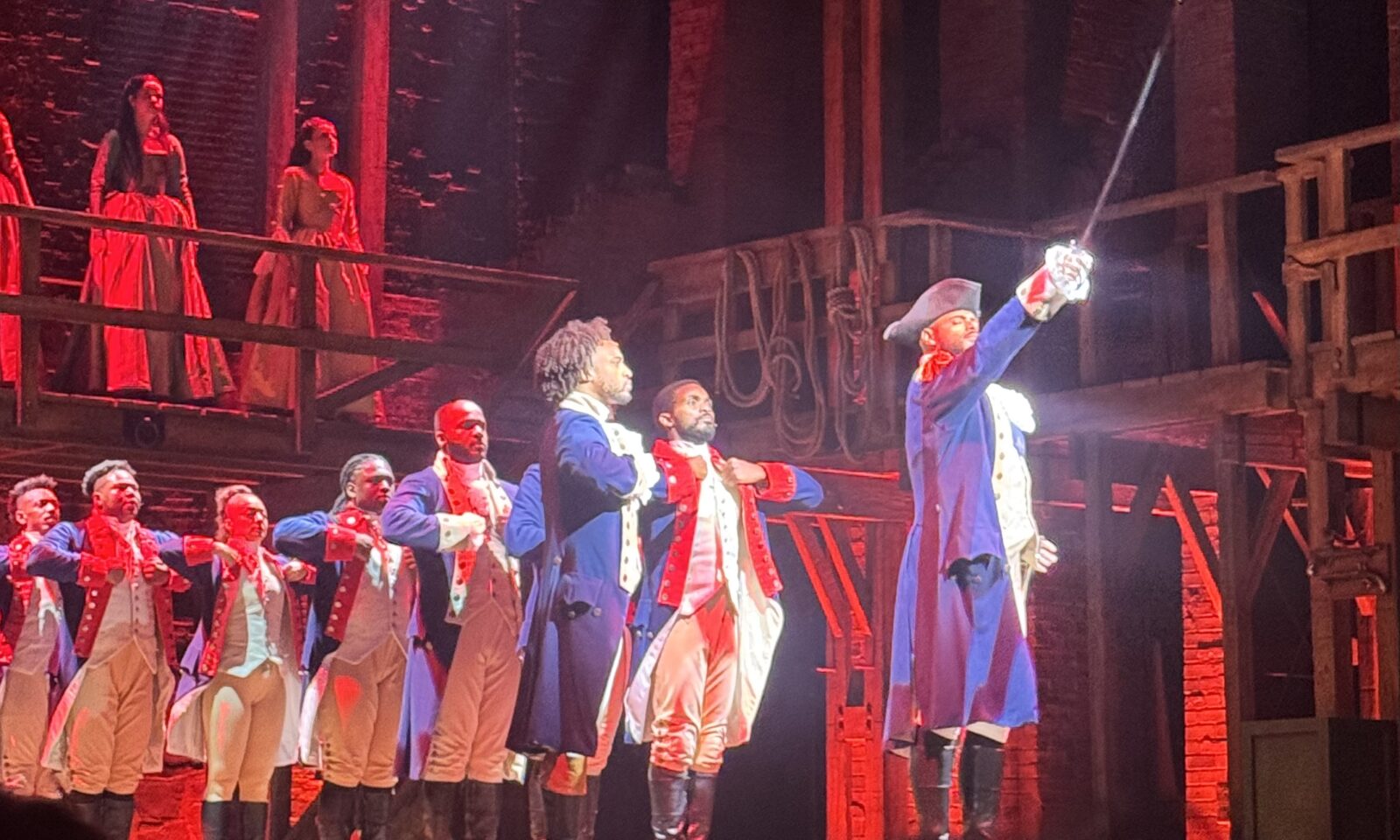
At Fort Lauderdale’s Broward Center, a formidable touring company restores the urgency, wit and humanity of Lin-Manuel Miranda’s revolutionary musical at a moment when the American experiment is again on everyone’s mind.
There is something almost unnervingly appropriate about seeing Hamilton in the immediate aftermath of a consequential midterm election, during the year of America’s 250th anniversary of independence.
Eleven years after Lin-Manuel Miranda’s musical opened on Broadway, its central questions have lost none of their sting. Who gets to shape a nation? Who is permitted a voice in its future? What are the costs of conviction, compromise and personal ambition? And, inevitably, who gets to tell the story?
At the Broward Center for the Performing Arts, the touring company makes a persuasive case that Hamilton is no museum piece. Its construction is dazzlingly precise, its emotional stakes undiminished, and its quarrels with the American ideal remain very much alive.
Two formidable inheritances: Hamilton and Burr
Any performer who assumes Alexander Hamilton’s coat inherits an unusually daunting task. Miranda did not simply originate the title role; he helped rewrite the grammar of musical theater in doing so. Tyler Fauntleroy meets that inheritance by making Hamilton’s restless intelligence the driving force of the evening. He captures both the exhilarating audacity and the self-destructive impatience of a man who believes every silence is a missed opportunity.
Fauntleroy’s Hamilton is compelling because the qualities that make the character magnetic also make him difficult to love. His brilliance can harden into certainty, his loyalty into obsession, his appetite for history into an inability to live in the present. The performance keeps those contradictions in view rather than smoothing them into heroism.
Across from him, Deon’te Goodman offers an Aaron Burr of considerable inward tension. The role, indelibly associated with Leslie Odom Jr.’s original interpretation, demands that an actor convey an entire philosophy of self-restraint while the world rewards its opposite. Goodman makes Burr’s cautious calculations feel human rather than merely villainous. One can see the exhaustion of a man who has spent his life waiting for the right moment as another man takes every available one.
The two actors give the musical its crucial axis: Hamilton’s refusal to wait against Burr’s refusal to risk. Their rivalry is political, certainly, but its final tragedy emerges from something more intimate — two men whose approaches to power have become inseparable from their ideas of themselves. Both performers fill enormous shoes while creating room for their own emphases.
Eliza, the keeper of the story
The musical’s moral gravity belongs in large measure to Lily Soto as Eliza Hamilton. Amid the swagger, ambition and verbal combat, Eliza insists on the human consequences of public greatness: the lives interrupted, the intimacies betrayed, the labor of remembering.
Soto gives Eliza a palpable dignity without reducing her to sainthood. As the story turns from nation-building to domestic fracture and loss, she becomes its quiet center of gravity. The finale ultimately belongs not to a president, a general or a treasury secretary, but to a woman determining what survives after the famous men have departed the stage.
Marja Harmon lends Angelica Schuyler a fine counterpoint: quick intelligence, emotional clarity and a sharp awareness of the limits imposed on women of her time. Together, the sisters remind us that the republic’s history includes not only the people whose names became monuments but those asked to live within the structures those men created.
Jefferson enters — and the argument changes key
The second-act arrival of Thomas Jefferson remains one of the production’s great theatrical pleasures. Christian Magby, who also plays the Marquis de Lafayette in Act I, makes the transition a showcase for the show’s extravagant tonal range. Lafayette arrives animated by revolutionary possibility; Jefferson returns from France wearing confidence like an especially elaborate costume.
Magby’s Jefferson has the buoyant theatrical swagger the role demands, but the comedy is pointed. Miranda makes economic policy and federal power into the stuff of musical confrontation: cabinet debates staged with the competitive snap of a battle. The audience laughs, then recognizes the seriousness beneath the performance. Arguments over executive authority, fiscal priorities and the meaning of a new republic never stopped being current.
A machine that still feels alive
Thomas Kail’s staging and Andy Blankenbuehler’s choreography remain models of theatrical economy. David Korins’ brickwork, timber scaffolding and revolving stage create a spare world in which bodies seem to move history itself. The same physical space accommodates a battlefield, a cabinet argument, a family and a duel; the transitions feel less like changes of scenery than turns of the historical wheel.
The music continues to astonish not only for its verbal density but for its cultural proposition. Hip-hop, R&B and Broadway idioms are not decorative updates to a traditional founding-fathers pageant. They are the language through which the show argues that American history is neither the property of one era nor one kind of American.
That proposition was radical in 2015. Eleven years later it remains essential, even as the musical’s immense popularity has made some of its once-startling choices familiar.
After the midterms, democracy as unfinished work
In the days following the 2026 midterm elections, Hamilton offers neither partisan consolation nor an easy civics lesson. Its founders disagree fiercely about power, government, finance, international alliances and the future of the country they have helped create. Their genius is inseparable from their limitations; their lofty language about liberty exists alongside the realities of slavery and exclusion.
The show’s most useful lesson is not that its protagonists were flawless, but that the American experiment was contested from the beginning. Democracy was never a finished inheritance. It is an argument each generation must conduct anew: who is represented, who is heard, how power should be exercised, and what obligations a nation owes those who come after its celebrated founders.
Those questions belong to neither party. Two hundred and fifty years after the Declaration of Independence, the republic is still defining the reach of its founding promises. The diversity of the artists telling this story onstage is itself part of that unfinished conversation.
The next generation hears it differently
Watching the production alongside my teenage son brought another dimension to the evening. For a young audience member, the names from a history textbook emerge as passionate, fallible people whose choices produce consequences far beyond their own lifetimes.
This, perhaps, is the musical’s most durable achievement. It makes history accessible without making it inconsequential. It renders political disagreement thrilling without pretending disagreement is a failure, and it insists that history is composed not only of celebrated victories but of those who preserve and interrogate their meaning.
Who tells the story now?
Eleven years after Broadway first embraced Hamilton, this touring production could have been content to serve as a handsome monument to a modern classic. Instead, Fauntleroy and Goodman make its central conflict freshly felt; Soto gives its emotional conclusion a beating heart; Magby turns intellectual combat into exhilarating theater. The surrounding company sustains the demanding rhythmic and physical life of the work.
What remains after the curtain is not merely admiration for a beautifully engineered show. It is a sense of responsibility — to history, to the people excluded from its first drafts and to the generation that will write the next chapter.
Hamilton reminds us that history is not simply what happened. It is what we choose to do with what we inherited.
In the nation’s 250th anniversary year, that is still an urgent message — and this production delivers it with enormous conviction.
Hamilton plays the Broward Center for the Performing Arts in Fort Lauderdale through November 22, 2026. NextNow attended the November 12 performance. Confirmed principal credits for that performance include Tyler Fauntleroy (Alexander Hamilton), Deon’te Goodman (Aaron Burr), Lily Soto (Eliza Hamilton), Marja Harmon (Angelica Schuyler), Christian Magby (Lafayette/Thomas Jefferson), Auston Henderson (George Washington), Michael Natt (Hercules Mulligan/James Madison) and Alex Dorf (King George III). NextNow will continue its coverage with interviews featuring touring company members.