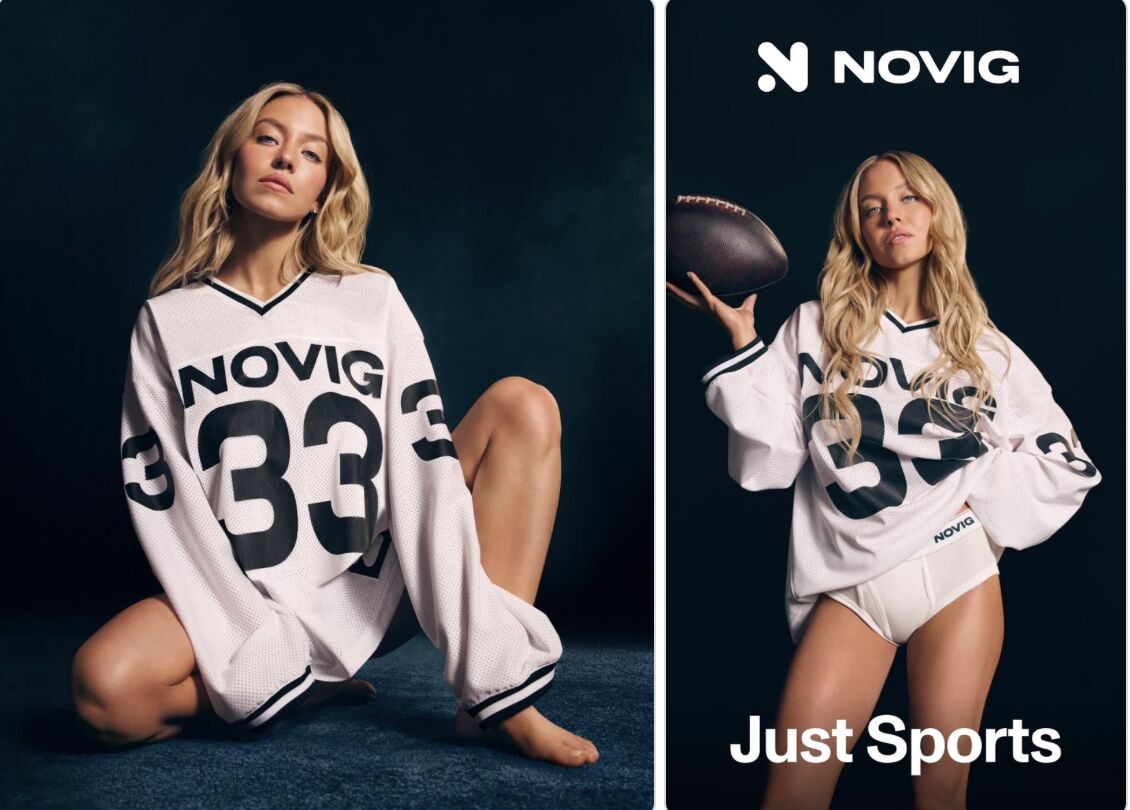
Novig’s first national brand campaign is designed around an old advertising truth: before a new brand can persuade anyone, it has to be noticed. The sports prediction market recruited Sydney Sweeney for a deliberately provocative launch built around an unusually simple message — Novig is about sports, and only sports.
The campaign, called “Just Sports”, puts Sweeney in a series of sports settings and uses visual provocation as the setup for a narrower product promise. Novig’s pitch is that unlike broader prediction platforms, users will not find markets tied to politics, wars, deaths or other news events. The entire product is built around sports.
Sweeney is not simply a paid spokesperson. Novig says she has joined the company as a strategic partner and equity holder, tying her more directly to the brand’s growth.
The creative is doing two jobs at once
On the surface, the campaign is engineered for virality. Entertainment Weekly reported that the spot drew more than 3 million views on X within hours, even as platform guidelines limited distribution on Instagram and TikTok. The visual concept is difficult to separate from Sweeney’s broader advertising persona, which has increasingly relied on campaigns willing to generate argument as well as attention.
But the more interesting design decision is underneath the provocation: the ad reduces Novig’s positioning to two words.
Just Sports.
That matters because prediction markets are entering a customer-acquisition fight in which many competing products can look functionally similar to casual users. Kalshi and Polymarket have built broad event-market brands. Traditional sportsbooks already own massive mindshare around football season. Novig needs consumers to remember not only its name, but why it is different.
The campaign makes that distinction visual. Every prop, setting and line points back to sports, while the copy explicitly rejects categories Novig does not offer. The creative may be provocative, but the strategy is disciplined.
Celebrity attention is becoming a category cost
Novig’s campaign also lands in the middle of a broader celebrity arms race. Prediction-market companies and adjacent sports platforms are spending heavily to reach mainstream consumers as football season begins. Polymarket has launched a campaign featuring LeBron James alongside other prominent sports and entertainment figures, while other platforms are building partnerships across leagues, athletes and media.
That makes Sweeney’s equity role notable. An ownership stake changes the structure of the endorsement: the celebrity has a reason to keep participating if the brand grows, and the company gets the possibility of a longer relationship instead of a one-off media buy.
It also raises the stakes. If the creative becomes more memorable than Novig itself, the company has paid for cultural attention without building much brand equity. The best provocative campaigns leave consumers remembering both the controversy and the proposition.
The real test starts after the views
For a challenger brand, earned attention can compress months of awareness-building into a few days. That is especially valuable in a market where larger competitors can outspend a startup across television, sports sponsorships and performance media.
But attention is only the opening metric. Novig will ultimately have to convert curiosity into funded accounts, repeat use and a recognizable position in the sports market.
The campaign’s strongest design choice may therefore be its simplest one. Strip away the celebrity, the provocation and the social-media debate, and the audience is still left with a message that can fit on a billboard:
Novig is just sports.
That is the part competitors may find hardest to copy.