
Artificial intelligence has transformed the creative industry at an astonishing pace. Today, businesses can generate logos, social media graphics, advertisements, presentations, and even complete brand identities in minutes using AI-powered design tools. For organizations looking to move quickly or reduce costs, the appeal is obvious.
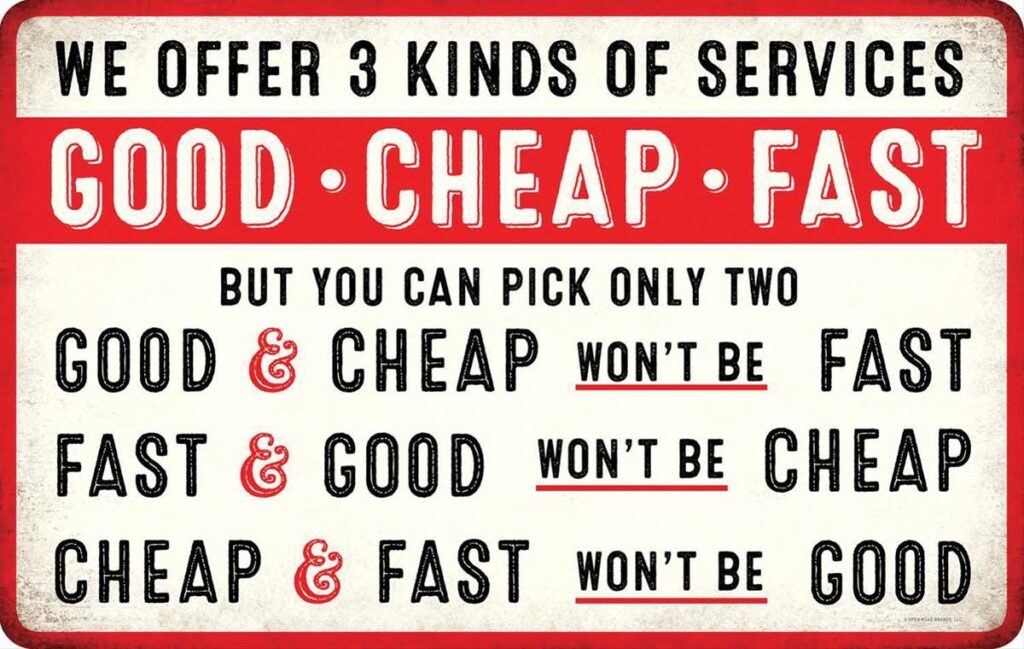
But speed and affordability are not the same as strategic value. It reminds me of the Project Management Triangle: Good, Fast, Cheap – Pick two.
While AI has become a powerful tool for accelerating production and automating repetitive tasks, it cannot replace the experience, critical thinking, and creative intuition that professional designers bring to a business. For companies building brands, launching products, or competing in crowded markets, originality and strategic thinking remain the true competitive advantage.
For CEOs, hiring an experienced creative designer isn’t simply about producing attractive visuals, but investing in a strategic partner who understands how design influences perception, trust, and business growth. For CMOs and marketers, experienced designers ensure every campaign aligns with a cohesive brand strategy. And for organizations seeking long-term success, human creativity remains one of the few advantages that cannot be automated.
AI Is a Tool—Not a Creative Strategy
Artificial intelligence excels at recognizing patterns.
It analyzes enormous collections of existing images, layouts, typography, colors, and design styles to generate new content based on statistical probability. The results can often appear polished, professional, and visually impressive.
However, AI doesn’t understand your business.
It doesn’t interview stakeholders, challenge assumptions, identify market opportunities, or uncover the emotional motivations that drive purchasing decisions. It cannot facilitate brand workshops, interpret organizational culture, or navigate complex business objectives.
Experienced designers don’t simply create graphics—they solve problems.
Every color choice, layout decision, typography selection, and visual element should support a broader strategic objective. Design becomes meaningful because it is informed by research, context, experience, and intentional decision-making.
Without strategy, even beautiful design can fail to achieve business goals.
Creativity Comes From Human Experience
The most memorable brands are built on ideas that feel authentic, emotionally resonant, and culturally relevant.
These qualities emerge from human experience. Not algorithms.
Experienced creative professionals draw upon years of observation, collaboration, failures, successes, industry knowledge, and intuition developed through solving hundreds of unique design challenges.
They recognize subtle nuances such as:
- Audience psychology
- Cultural context
- Market trends
- Competitive positioning
- Consumer behavior
- Emotional storytelling
They ask questions AI cannot. Why does this matter to customers? How should this brand make people feel? What opportunity has every competitor overlooked?
These conversations often lead to breakthrough ideas that no prompt alone can generate.
Great branding begins with curiosity, empathy, and strategic thinking—qualities that remain fundamentally human.
Originality Requires More Than Pattern Recognition
One of the greatest challenges with AI-generated design is originality.
AI creates by learning from existing work. While it produces new combinations, those combinations are influenced by patterns found across millions of prior designs.
As more businesses rely on the same AI tools and similar prompts, visual identities begin to converge. Logos, layouts, illustrations, and marketing graphics often start looking remarkably alike.
For businesses trying to differentiate themselves, this presents a significant problem.
Strong brands succeed because they are recognizable, memorable, and distinctive.
Experienced designers intentionally seek unique solutions tailored to a company’s goals, audience, and market position. Rather than relying on the most statistically likely design outcome, they pursue ideas that create meaningful differentiation.
In competitive industries, originality isn’t a luxury—it’s a business necessity.
Strategic Designers Understand Business Objectives
Professional designers are often underestimated because their work is viewed primarily through an aesthetic lens.
In reality, experienced creative professionals spend far more time thinking than designing.
Before opening design software, they ask strategic questions:
- What business problem are we solving?
- Who is the target audience?
- What action should this design inspire?
- How does this support the broader brand?
- What differentiates this organization?
The resulting creative work is intentional rather than decorative.
AI can only generate options.
Experienced designers determine which option best serves the business.
That distinction has enormous implications for marketing effectiveness, customer perception, and long-term brand equity.
Brand Consistency Cannot Be Left to Chance
Successful brands are built through consistency.
Every customer interaction—from websites and advertising to presentations, packaging, signage, and social media—should reinforce the same identity.
Experienced designers think beyond individual projects.
They develop scalable design systems that include:
- Visual identity standards
- Typography systems
- Color palettes
- Brand guidelines
- Design templates
- Photography direction
- Motion principles
- Accessibility considerations
These systems enable organizations to grow without sacrificing consistency.
AI can produce individual assets quickly, but maintaining a cohesive visual language across hundreds of touchpoints still requires strategic oversight and creative leadership.
AI Lacks Context and Judgment
Design is rarely a straightforward exercise.
Business priorities change. Markets evolve. Audiences respond unexpectedly. Stakeholders have competing objectives.
Experienced designers navigate these complexities by balancing creativity with practical business considerations.
AI cannot participate in strategic discussions, negotiate competing priorities, interpret nuanced feedback, or understand organizational dynamics.
It also lacks judgment.
A designer knows when to break conventions, when to simplify, when to challenge a client’s assumptions, and when restraint creates greater impact.
Those decisions come from experience—not computation.
Where AI Adds Real Value
None of this means AI should be avoided.
In fact, many experienced designers use AI every day.
AI can dramatically improve productivity by assisting with:
- Early concept exploration
- Image generation
- Mood boards
- Copy ideation
- Background removal
- Asset organization
- Production automation
- Repetitive design tasks
Used thoughtfully, AI allows creative professionals to spend less time on routine production and more time solving complex creative problems.
The strongest creative teams don’t compete against AI—they leverage it strategically.
The difference is that AI remains the assistant, not the creative director.
Why Human Creativity Remains a Competitive Advantage
As AI-generated content becomes increasingly common, originality becomes increasingly valuable.
Consumers are exposed to thousands of marketing messages every day. Most are quickly forgotten.
The brands that stand out are those with authentic stories, distinctive voices, thoughtful experiences, and memorable creative work.
These qualities emerge from collaboration, empathy, observation, experimentation, and strategic thinking.
They emerge from people.
Businesses that invest in experienced creative professionals gain more than polished visuals. They gain strategic partners who help define how customers perceive their brand, how employees represent the organization, and how the company competes in the marketplace.
In an era of automation, genuinely human creativity becomes even more valuable because it is increasingly rare.
The Bottom Line
Artificial intelligence is transforming the way creative work is produced, and its benefits are undeniable. It accelerates workflows, increases efficiency, and empowers teams to move faster than ever before.
But speed alone does not create meaningful brands.
The most successful organizations recognize that AI is a powerful tool—not a replacement for creative expertise. Experienced designers bring strategic thinking, business insight, originality, empathy, and creative judgment that no algorithm can replicate.
For business leaders, the question isn’t whether to use AI. The question is how to use it wisely.
The most effective approach combines the efficiency of AI with the vision of experienced creative professionals. AI can accelerate execution, but only human creativity can define a brand’s purpose, uncover its unique story, and create the emotional connections that inspire lasting loyalty.
Technology may continue to change the creative process, but the businesses that lead tomorrow will still be those that invest in the one resource AI cannot reproduce: human imagination.